AI for ultrasound imaging
What software does with raw echoes
Ultrasound produces noisy, operator-dependent images. Machine learning has changed that in cardiology and obstetrics, and FDA has cleared the tools. S-WAVE™ is designed to bring the same capabilities to a fixed dental tray.
The S-WAVE™ pipeline
From raw echoes to a flagged change
1 · Reconstruct
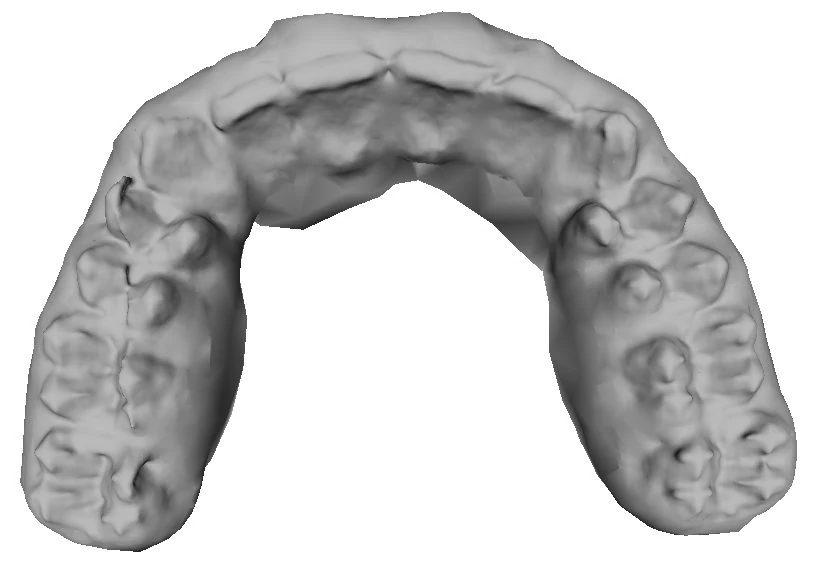
Echoes from every sensor position become a point cloud, a mesh and a surface.
2 · Clean and segment
Denoise, remove couplant and saliva artefacts, separate teeth from gum and bone, label each tooth.
3 · Register and measure
Align each scan to last month’s; measure enamel, gum thickness and bone level per tooth.
4 · Flag, don’t diagnose
Only changes above a threshold go to a dentist. The dentist decides; the software never does.
Capabilities
What AI already does for ultrasound, and what it will do here
Image quality guidance
Real-time feedback that tells the user the probe or tray is seated correctly. FDA authorized the first AI guidance for cardiac ultrasound by novices in 2020 (De Novo); the same idea is designed into the S-WAVE™ app.
Automatic measurement
Cleared echo tools measure ejection fraction without a sonographer; S-WAVE™ is designed to measure bone level and gum thickness per tooth automatically.
Change detection over time
Registration of serial scans is routine in radiology AI; applied monthly, it turns a scan into a trend.
Quality assurance
Reject unusable scans before they reach a dentist, so review time goes to real findings.
Training data
The acquired research data set and bench scans are the starting point; patient data will come only under the FDA testing plan with consent.
Updates under control
A Predetermined Change Control Plan lets an AI device improve after authorization within pre-agreed bounds, without a new submission each time.
Dental precedents
AI in dentistry FDA has already cleared
Radiograph analysis
Several AI products that detect caries and bone loss on dental X-rays have 510(k) clearance as aids to dentists. They prove the regulatory path for dental image AI, on radiographs.
Phone-photo monitoring
A De Novo authorization in 2023 for AI analysis of patient-taken dental photos established the home-monitoring category with clinician review.
What is new in S-WAVE™
The same two precedents, applied to ultrasound volumes instead of photos or radiographs, captured at home from a fixed tray.
Precedent devices are not KronosMD products and their clearances do not predict S-WAVE™’s. S-WAVE™ software does not exist yet; its standalone performance and clinical accuracy are part of the FDA testing plan.
Dental imaging without radiation, from home.
Questions about S-WAVE™, the research or a collaboration? Our team is here to help.